Your agent fleet,
with suspenders.
Five parallel Claude Code sessions. A usage cliff freezes three mid-edit. The survivors keep editing the same files; nobody notices for six hours. Suspenders is the control plane that notices — and the board where you decide what happens next.
The board — monitoring and task completion in one surface
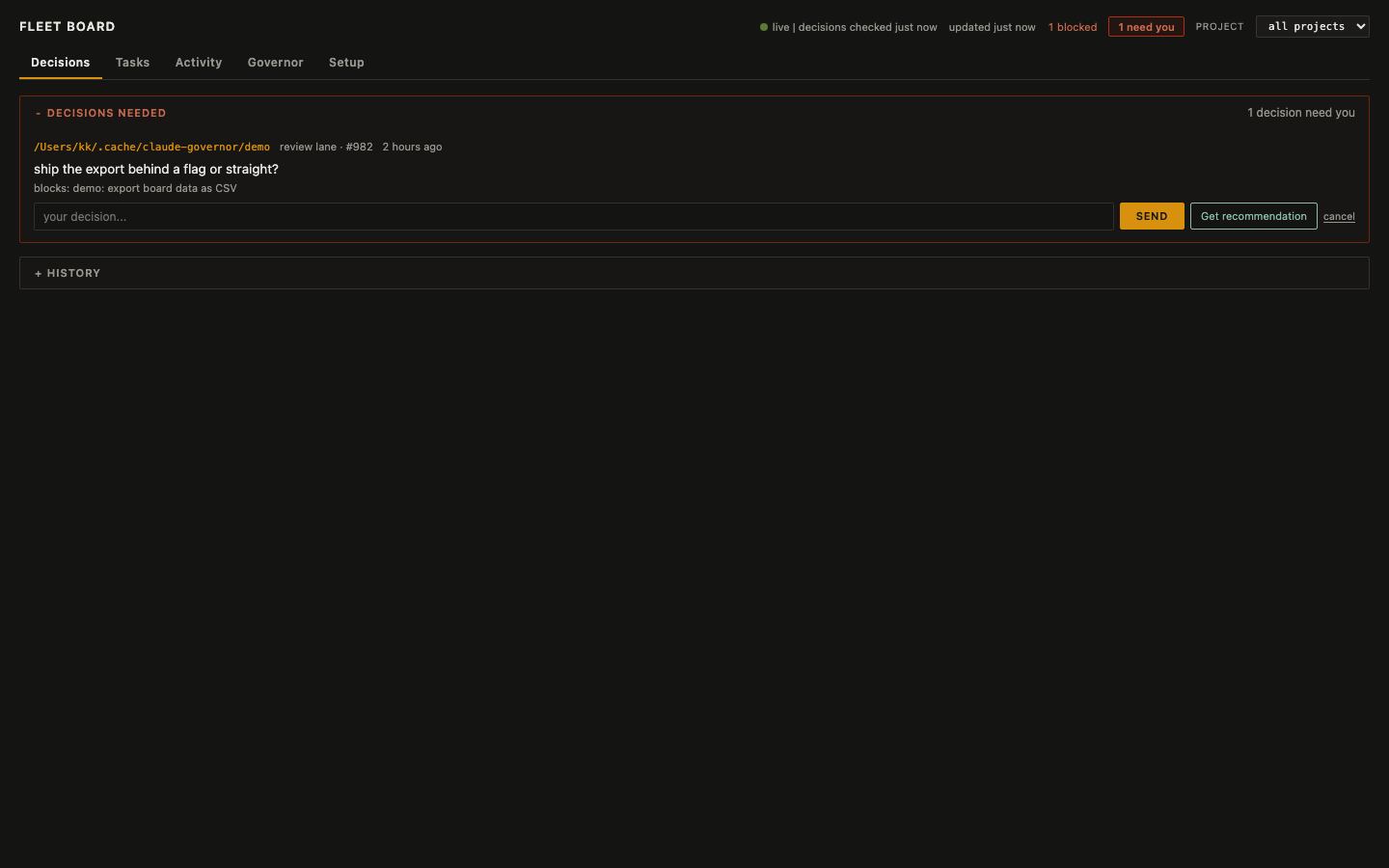
Open decisions surface as red cards. Get recommendation has an LLM analyze the decision in control-plane context; you edit or send. Lanes, completion stats, and the event stream stay live at 1s.
How a decision resolves
NEED_DECISION
instead of blocking silently
ANSWER. Recommendations are suggestions; only you send.
What it enforces
secrets-gate before every Bash call · file leases on edits · capability-aware dispatch · plan-gated fan-out · zombie detection that never mistakes a failed lookup for death · no auto-reclaim — reclaiming a lane is your call
Messaging, consults, and the human in the loop
sequenceDiagram
    autonumber
    participant L as Lane (worker session)
    participant C as Coordinator session
    participant G as governor.db (bus + graph)
    participant B as Fleet board (browser)
    participant A as advise.ts (LLM worker)
    participant H as Human operator

    Note over L,G: work and checkpoints are structured events in the database
    L->>G: work take W7 (CAS claim, capability-checked)
    L->>G: emit checkpoint --sha (milestone)
    L->>G: emit NEED_DECISION (decision raised)

    G->>B: 1s poll — decision card (red, asker, age)
    B->>H: "2 decisions need you"

    alt human wants machine advice
        H->>B: click "Get recommendation"
        B->>A: POST /api/advise (spawn, detached)
        A->>G: read claims, recent events, graph shape
        A->>A: LLM call (OpenAI-compatible, autodiscovered)
        A->>G: fact advice.#id + ADVICE event
        G->>B: recommendation inline (rec / rationale / risk / model)
        B->>H: "use" fills the answer field
    end

    H->>B: edit decision, send
    B->>G: emit ANSWER --to lane (auto-acks the decision)
    G->>L: lane inbox sees ANSWER on next poll

    Note over L,C: consults — one agent asks another a question
    L->>G: coord who-knows "retry contracts?"
    G->>C: consult C## in expert inbox
    C->>G: coord consult-reply C## answer
    G->>L: answer lands in lane inbox

    Note over G,H: zombie detection — two stale signals alert; reclaim is human
    G->>B: zombie chip (lane frozen by usage cliff)
    H->>G: work reclaim W4 — re-dispatch at frozen transcript
Rendered with mermaid — the same diagram lives in the README. The database is the transport, consults only carry answers between agents, and only you answer decisions or reclaim lanes.
Architecture
bun CLIs + hook gates
  │ SessionStart → bootstrap session, caps, transcript_path
  │ PreToolUse   → secrets / edit-enforce / governor lease
  ▼
governor.db (SQLite/WAL) — sessions · claims · work graph · events · facts
  ▲ 1s poll (WAL = concurrent readers)
fleet board — decisions · lanes · tasks · stream   ← you, deciding
Why "suspenders"
Belt and suspenders: the graph is the record, and a lane is only flagged dead after two independent signals — heartbeat and transcript — both go stale. Task state lives in the database, so any session — restarted, compacted, or brand new — sees the same queue.